
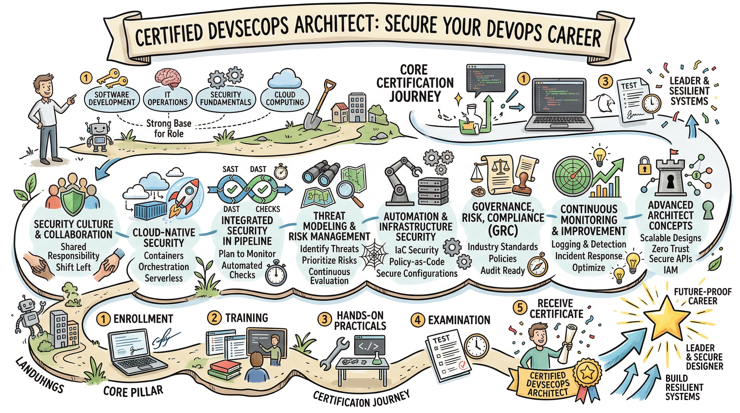
Modern software delivery is no longer only about speed. It is also about security, compliance, resilience, and trust. Teams are expected to ship faster, but they are also expected to build safer pipelines, protect cloud workloads, secure containers, manage compliance, and reduce risk across the entire software delivery lifecycle. That is why the Certified DevSecOps Architect program matters. The official certification page describes it as a program focused on designing and building scalable, resilient, and compliant DevSecOps architectures, with coverage including secure coding practices, automated compliance, threat modeling, container orchestration, and cloud-native security.
This guide is written for working engineers, software professionals, and managers who want a practical understanding of what this certification offers, who should take it, how to prepare, and what to do after it. I am also treating one line in your prompt as a typo: although it says “About Certification name – Master in Observability Engineering,” the provided official URL clearly points to Certified DevSecOps Architect, so this guide is built around that certification.
What Is Certified DevSecOps Architect?
Certified DevSecOps Architect is an architect-level certification for professionals who want to design secure DevOps systems at enterprise scale. Based on the official page, the program goes beyond basic DevSecOps practices and focuses on architecture decisions: security blueprints, resilient delivery design, secure cloud-native systems, compliance-aware pipelines, and end-to-end security integration across development, operations, and infrastructure.
In simple words, this certification is for people who do not just want to use DevSecOps tools. It is for people who want to design the whole model: how security fits into CI/CD, how teams should structure cloud-native controls, how policy and compliance are automated, and how delivery systems stay secure without slowing down engineering. DevSecOpsSchool’s certification catalog places Architect alongside Engineer, Manager, and Professional tracks, which shows it is part of a broader role-based path rather than a single isolated course.
Why This Certification Matters
Many organizations already have DevOps pipelines, but those pipelines are often not secure by design. Security checks may be added late, compliance can become manual, and cloud environments may scale faster than governance. The value of an architect-level DevSecOps certification is that it helps professionals design security into the system from the start. The official certification page highlights enterprise-grade security architecture, automated compliance, and secure cloud-native patterns as core parts of the program.
This matters for engineers because senior roles increasingly require architecture thinking, not just tool execution. It matters for managers because secure delivery is now tied to business continuity, audit readiness, and customer trust. It also matters for software engineers who want to move from implementation to design, because architect-level credentials signal an ability to think across teams, controls, pipelines, and platforms. GurukulGalaxy’s roundup of software engineering certifications also places DevOps- and security-adjacent certifications among the kinds of paths valued by software and IT professionals, which supports the career relevance of this direction.
Certification Deep Dive: Certified DevSecOps Architect
What it is
Certified DevSecOps Architect is an advanced program for designing secure software delivery architectures. It focuses on building systems where security is integrated across the SDLC, cloud infrastructure, container environments, and automation workflows instead of being added later as a separate control layer.
Who should take it
This certification is a good fit for:
- Senior DevOps Engineers
- Security Engineers
- Platform Engineers
- Cloud Engineers
- Site Reliability Engineers
- Technical Architects
- Engineering Managers
- Team leads responsible for secure software delivery
These role patterns align with the Architect positioning on the official page and with DevSecOpsSchool’s broader role-based certification structure.
Skills you’ll gain
- Designing secure CI/CD architectures
- Applying threat modeling in delivery workflows
- Building secure cloud-native and container-based systems
- Integrating compliance into pipelines
- Designing security controls across development, testing, deployment, and operations
- Understanding secure coding and governance alignment
- Building resilient DevSecOps blueprints for enterprise environments
- Aligning architecture decisions with security standards and risk reduction
These skills come directly from the official description, which calls out secure coding, automated compliance, threat modeling, container orchestration, cloud-native security, and enterprise-grade design.
Real-world projects you should be able to do after it
- Design a secure CI/CD pipeline for a cloud application
- Build a DevSecOps reference architecture for containerized workloads
- Add automated compliance gates to a release workflow
- Map threat models to build, test, and deployment stages
- Improve security architecture for Kubernetes-based delivery systems
- Define guardrails for secrets, images, policies, and runtime security
- Create an enterprise DevSecOps operating model for multiple teams
- Review an existing pipeline and redesign it for stronger security and resilience
These projects are consistent with the architect-level outcomes described on the official certification page.
Preparation plan
7–14 days
Best for experienced DevOps or security professionals who already understand CI/CD, cloud platforms, containers, and security controls. Use this period for focused revision on architecture patterns, compliance design, threat modeling, and pipeline security.
30 days
Best for most working professionals. Spend week one on DevOps and cloud security basics, week two on DevSecOps controls, week three on architecture patterns and compliance automation, and week four on real-world design scenarios and mock questions.
60 days
Best for engineers transitioning from implementation to architecture. Start with DevOps foundations, then move into security tooling, cloud-native security, container risk, policy automation, and architect-style design thinking.
Common mistakes
- Treating DevSecOps as only tool integration
- Focusing only on scanners and not architecture
- Ignoring compliance automation
- Designing controls that slow delivery too much
- Forgetting developer experience in security design
- Not thinking about secrets, identity, and policy together
- Skipping threat modeling
- Assuming cloud security defaults are enough
Best next certification after this
The strongest next step depends on your goal:
- Same track: Certified DevSecOps Manager if you want to move from architecture into strategy, policy alignment, and leadership. The official Manager page frames that program around aligning DevSecOps with business objectives, compliance mandates, and team culture.
- Cross-track: Certified Site Reliability Architect if you want to pair secure architecture with reliability and scale design. SRESchool positions its Architect certification around designing reliable and scalable systems.
- Leadership/business: Certified FinOps Architect if you want architecture decisions to include cost accountability and cloud governance. FinOpsSchool lists Architect as part of its certification catalog.
Choose Your Path
DevOps Path
Start with DevOps foundations, CI/CD, infrastructure automation, and release engineering. Then move into Certified DevSecOps Architect to make those delivery systems secure by design. This path is ideal for engineers who already know automation but want to add governance and secure architecture. DevSecOpsSchool’s catalog shows role-based growth from DevSecOps Professional and Engineer toward Architect and Manager.
DevSecOps Path
This is the most direct path. Learn security in the SDLC, pipeline controls, container and cloud security, then use Certified DevSecOps Architect to design the full enterprise model. The official Architect page clearly supports this advanced design-oriented direction.
SRE Path
SRE and DevSecOps overlap in production safety, resilience, automation, and operational discipline. If you are working in reliability-heavy systems, this certification helps you design security into those systems rather than adding it later. SRESchool’s certification catalog includes Engineer, Professional, Architect, and Manager tracks that can complement this path.
AIOps / MLOps Path
AIOps focuses on intelligent operations, predictive monitoring, and automation. AIOpsSchool positions its programs around AI-driven IT operations, monitoring, and self-healing systems, which makes it a useful cross-track path after a security architecture foundation.
DataOps Path
If your environment includes data platforms and analytics pipelines, a DataOps path helps extend DevSecOps architecture into data reliability, lifecycle control, and quality operations. DataOpsSchool describes itself as focused on building and running modern data platforms with hands-on training and certifications.
FinOps Path
If you are moving toward architecture leadership, security decisions and cloud cost decisions start to overlap. FinOpsSchool positions its certifications around cloud cost governance, engineering collaboration, and value-driven control, which fits well after secure cloud architecture training.
Role → Recommended Certifications
| Role | Recommended certifications |
|---|---|
| DevOps Engineer | DevSecOps Professional → DevSecOps Engineer → Certified DevSecOps Architect |
| SRE | Site Reliability Professional → Site Reliability Architect → Certified DevSecOps Architect |
| Platform Engineer | DevSecOps Engineer → Certified DevSecOps Architect → Site Reliability Architect |
| Cloud Engineer | DevSecOps Engineer → Certified DevSecOps Architect → FinOps Engineer / Architect |
| Security Engineer | DevSecOps Professional → DevSecOps Engineer → Certified DevSecOps Architect |
| Data Engineer | DataOps Professional → Certified DevSecOps Architect → AIOps Professional |
| FinOps Practitioner | FinOps Engineer → FinOps Architect → Certified DevSecOps Architect |
| Engineering Manager | Certified DevSecOps Architect → DevSecOps Manager → FinOps Manager |
Next Certifications to Take After Certified DevSecOps Architect
1. Same Track
Certified DevSecOps Manager
This is the best next move if you want to lead security transformation, governance, compliance, and team-wide DevSecOps operating models. The official Manager page presents it as a strategic program for managers, technical leads, and security executives.
2. Cross-Track
Certified Site Reliability Architect
This is a strong option if you want to combine secure architecture with uptime, reliability, scalability, and large-system design. The SRESchool Architect certification is explicitly built for experienced professionals designing reliable and scalable systems.
3. Leadership
Certified FinOps Architect
This is useful for professionals who want to influence cost governance, cloud efficiency, and business-aligned platform decisions at the architecture level. FinOpsSchool lists Architect among its formal certification tracks.
Top Institutions for Certified DevSecOps Architect Training
DevOpsSchool:
A recognized training ecosystem with hands-on, job-oriented technical learning. Its broader network and training style support engineers who want structured practical growth across DevOps and adjacent domains.
Cotocus:
Commonly associated with implementation-focused support and real-world technical delivery. It is useful for learners who want more practical context around enterprise adoption patterns.
ScmGalaxy:
Helpful for learners who want extra community resources, tutorials, and technical guidance that can complement formal training.
BestDevOps:
Known in the same broader ecosystem for practical and career-focused learning support, especially for engineers preparing for role growth.
devsecopsschool.com:
The most direct source for this certification, with official Architect, Engineer, Manager, and Professional tracks under one catalog.
sreschool.com:
A strong companion platform if you want to connect secure architecture with reliability engineering and scalable systems. Its certification catalog includes Engineer, Professional, Architect, and Manager paths.
aiopsschool.com:
Useful for engineers who want to extend secure architecture into AI-driven operations, predictive analytics, and automation.
dataopsschool.com:
A relevant option for professionals working on secure data pipelines, analytics platforms, and operational governance for data systems.
finopsschool.com:
Helpful for professionals who want to connect cloud security architecture with cost visibility, governance, and engineering-finance alignment.
FAQs on Certified DevSecOps Architect
1. Is Certified DevSecOps Architect a beginner certification?
No. It is best suited for professionals who already understand DevOps, CI/CD, cloud platforms, containers, and basic security principles. The official page positions it as an architect-level program.
2. How difficult is this certification?
It is moderately high in difficulty because it requires design thinking, not only tool knowledge. You need to understand how security fits across systems, workflows, compliance, and cloud-native operations.
3. How much time should I prepare?
A strong practitioner may prepare in 7–14 days, most working professionals should plan for 30 days, and candidates moving into architecture often benefit from 60 days of steady study.
4. Do I need coding experience?
You do not need to be a full-time developer, but understanding application delivery, automation, and infrastructure-as-code concepts is very helpful.
5. Is this certification useful for cloud engineers?
Yes. The official scope includes cloud-native security and container orchestration, which are central to modern cloud engineering.
6. Is this certification only about security tools?
No. It is more about architecture, design decisions, control placement, compliance automation, and secure delivery models than about any single tool.
7. What should I learn before starting?
DevOps basics, CI/CD, containers, cloud fundamentals, security concepts, and automation workflows are the best starting points.
8. Does it help in leadership roles?
Yes. Architect-level certifications are useful for technical leads, platform leads, and managers who need to guide secure engineering decisions at scale. The official catalog also includes a Manager certification as a natural higher-level path.
9. What comes after Certified DevSecOps Architect?
Usually DevSecOps Manager for same-track growth, Site Reliability Architect for cross-track growth, or FinOps Architect for leadership and cloud-governance growth.
10. Is this certification valuable for software engineers?
Yes. It helps software engineers grow from secure coding and pipeline usage into security architecture and delivery-system design, which is valuable for senior growth.
11. Can SREs benefit from this certification?
Yes. SREs working on production systems, release safety, risk reduction, and resilient delivery can gain from DevSecOps architecture knowledge.
12. Is it worth the effort for career outcomes?
Yes. It is especially valuable for professionals aiming at architect, lead, platform, or secure-cloud roles because it builds a broader design mindset around secure software delivery. The official description emphasizes enterprise-grade design and compliance-aware architecture.
General FAQs on DevSecOps and Certification Journey
1. What is the main goal of DevSecOps?
The main goal of DevSecOps is to integrate security into every stage of the software development lifecycle so that applications are built, tested, and deployed securely without slowing down delivery.
2. How is DevSecOps different from traditional security?
Traditional security is often added at the end, while DevSecOps brings security into development, testing, and deployment from the beginning, making it continuous and automated.
3. Is DevSecOps only for large enterprises?
No. DevSecOps is useful for startups, mid-size companies, and enterprises. Any team building software can benefit from secure and automated practices.
4. Do I need to learn multiple tools for DevSecOps?
Yes, but more important than tools is understanding concepts like pipeline security, compliance automation, and secure architecture. Tools can change, but concepts stay relevant.
5. Can a non-security professional learn DevSecOps?
Yes. Many DevOps engineers, developers, and cloud engineers successfully transition into DevSecOps by gradually learning security concepts and applying them in pipelines.
6. How does DevSecOps improve software quality?
By catching vulnerabilities early, automating security checks, and reducing risks, DevSecOps helps deliver more stable, secure, and reliable applications.
7. Is certification enough to become a DevSecOps Architect?
Certification is a strong foundation, but real-world practice, hands-on projects, and experience in designing systems are equally important for becoming an architect.
8. What is the future scope of DevSecOps?
DevSecOps is growing rapidly with cloud, containers, and microservices. It will continue to be a critical skill as organizations focus more on secure and compliant software delivery.
Conclusion
Certified DevSecOps Architect is a strong choice for professionals who want to move from implementing tools to designing secure software delivery systems. It is not only about adding security checks to a pipeline. It is about building the full architecture for safe, scalable, compliant, and resilient delivery across teams and platforms. That makes it highly relevant for DevOps engineers, security engineers, cloud engineers, SREs, and engineering leaders who want to take on more responsibility.
The official certification page positions it as an enterprise-grade architecture program, and the broader training ecosystem around DevSecOpsSchool, SRESchool, AIOpsSchool, DataOpsSchool, and FinOpsSchool makes it easier to continue into adjacent paths after this step. If your goal is long-term growth in secure engineering leadership, this certification is a very solid next move.
