
Introduction
DevOps looks simple from outside: use Git, build a CI/CD pipeline, deploy faster, and monitor production. But in real companies, DevOps is about removing delays, reducing failures, and improving teamwork so software can move from idea to production safely.
That is why DevOps Certified Professional (DCP) matters. It gives you a clear DevOps foundation—how delivery really works, what practices teams follow, and how engineers and managers work together to ship reliable software. If you are starting DevOps or want a structured base for your career, DCP is a strong first step.
Who This Guide Is For
This guide is for working engineers and managers (India + global) who want a clear and practical understanding of DevOps through the DevOps Certified Professional (DCP) certification.
It is ideal for software engineers, QA engineers, system admins, cloud engineers, support engineers, and team leads who want to move into DevOps roles or strengthen their delivery knowledge. It is also useful for engineering managers who want to understand DevOps execution so they can guide teams better, reduce release delays, and improve stability.
What You Will Get From This Guide
In this guide, you will get a clear and practical understanding of the DevOps Certified Professional (DCP) certification and how it helps in real jobs.
You will learn what DCP covers, who should take it, what skills you will gain, and what real projects you should be able to handle after it. You will also get a step-by-step preparation plan (7–14 / 30 / 60 days), common mistakes to avoid, next certification options, learning paths, role-based mapping, and two sets of FAQs.
About Provider
DevOpsSchool is the official provider of the DevOps Certified Professional (DCP) certification. The provider focuses on building strong, job-ready DevOps fundamentals for working professionals and fresh learners who want a structured starting point.
Instead of teaching tools in isolation, the program approach is designed to help learners understand how real DevOps delivery works in companies—how code moves from development to testing to deployment, how teams reduce manual work using automation, and how collaboration improves speed and stability.
What Is DevOps Certified Professional (DCP)?
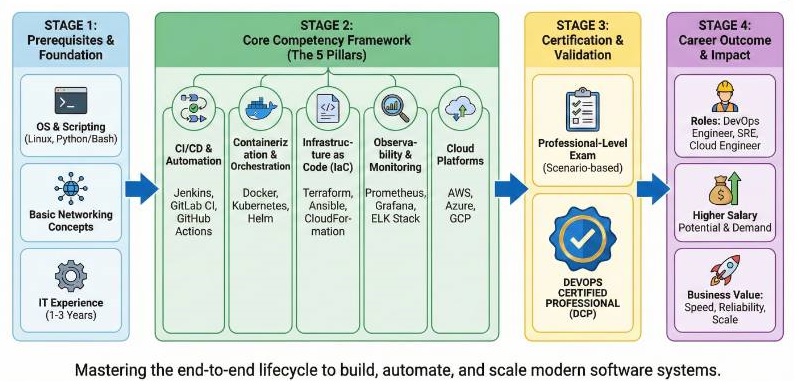
DevOps Certified Professional (DCP) is a foundation-level certification that validates your understanding of DevOps basics in a practical, job-friendly way. It covers how modern software delivery works—from planning and coding to testing, deployment, and monitoring—so you understand the full lifecycle, not just one tool.
DCP is meant for people who want a structured start in DevOps. It helps you learn the right concepts, common workflows, and team practices used in real companies, so you can confidently work with DevOps engineers, developers, testers, and operations teams.
Why DCP Matters for Working Engineers and Managers
DevOps is not only about tools like Git or CI/CD. It is about building a delivery system where teams can release changes safely and consistently.
DCP matters because it teaches the “whole picture,” such as:
- How work moves from code to production
- How teams reduce failures and speed up delivery
- How automation and good practices reduce manual effort
- How collaboration prevents last-minute surprises
For managers, DCP helps you understand what DevOps looks like in real execution, so you can guide teams in the right direction.
Certification Roadmap Table
Below is a roadmap-style table that helps you understand how DCP can fit with other common certification tracks.
Note: Only the DCP official link is included. Other links are not provided in your prompt.
| Certification | Track | Level | Who it’s for | Prerequisites | Skills covered | Recommended order |
|---|---|---|---|---|---|---|
| DevOps Certified Professional (DCP) | DevOps | Foundation | Beginners + working engineers starting DevOps | Linux basics, basic software lifecycle understanding | DevOps basics, CI/CD concepts, delivery flow | 1 |
| Certified DevOps Engineer (CDE) | DevOps | Intermediate | Engineers building automation and pipelines | DCP-level understanding | CI/CD, automation patterns, scripting usage | 2 |
| Certified DevOps Professional (CDP) | DevOps | Advanced | Engineers owning production delivery | Strong CI/CD + cloud basics | production readiness, reliability practices | 3 |
| Certified DevOps Manager (CDM) | DevOps | Leadership | Leads/managers owning delivery outcomes | Delivery ownership exposure | governance, adoption, improvement | 4 |
| Certified DevOps Architect (CDA) | DevOps | Architect | Platform/architecture owners | Strong DevOps maturity | scalable platform design | 5 |
| DevSecOps specialization | DevSecOps | Advanced | Security + delivery leaders | DevOps baseline | secure pipeline practices | Cross-track |
| SRE specialization | SRE | Advanced | Reliability owners | production ops exposure | incident maturity, SLO mindset | Cross-track |
| AIOps/MLOps specialization | AIOps/MLOps | Advanced | Ops automation leaders | monitoring/observability basics | automation and intelligent operations | Cross-track |
| DataOps specialization | DataOps | Advanced | Data engineering leads | data pipeline basics | data flow, quality, governance | Cross-track |
| FinOps specialization | FinOps | Advanced | Cost governance owners | cloud basics | cost visibility, optimization | Cross-track |
Who should take it
- Software engineers moving into DevOps or cloud roles
- QA engineers who want CI/CD understanding
- Freshers and early-career engineers who want structured DevOps entry
- System admins and support engineers shifting into automation
- Managers who want to understand DevOps execution and flow
Skills you’ll gain
- DevOps culture and collaboration mindset
- CI/CD fundamentals and pipeline flow
- Version control workflow basics
- Release flow understanding (build → test → deploy)
- Basic automation thinking and repeatable delivery habits
- Observability basics and feedback loop thinking
- Incident awareness and production responsibility mindset
Real-world projects you should be able to do after it
- Build a simple CI pipeline workflow concept for an application
- Create a structured release checklist for a small project
- Set up a basic branching strategy and team workflow for releases
- Design a simple “build-test-deploy” flow for dev and staging
- Create a small monitoring/alerting plan for an application
- Improve a manual process by converting it into steps and automation ideas
Preparation plan (7–14 days / 30 days / 60 days)
7–14 Days (Fast Track)
- Revise DevOps basics daily: culture, CI/CD flow, environments, and release steps
- Practice simple scenarios: “how code goes to production” and “why builds fail”
- Make short notes for quick revision and focus on clear explanations
30 Days (Balanced Plan)
- Week 1: DevOps fundamentals, roles, culture, and delivery lifecycle
- Week 2: Version control workflow + CI basics (build, test, artifacts)
- Week 3: CD basics (deploy flow, environments, rollback concepts, release checks)
- Week 4: Monitoring basics, incident awareness, and full revision with scenarios
60 Days (Deep + Practical Plan)
- Practice more scenarios, fix weak areas, and prepare strong answers for interviews
- Month 1: Learn slowly and clearly with strong basics and weekly revisions
- Month 2: Apply learning in a small project (even a demo project) and document steps
Common mistakes
- Learning tools randomly without understanding the delivery flow
- Thinking DevOps is only CI/CD and ignoring culture and ownership
- Skipping basics like Git workflow and release planning
- Memorizing definitions without doing small hands-on practice
- Ignoring monitoring basics and production responsibility
- Not practicing scenario questions (real-world thinking is required)
Best next certification after this
After DevOps Certified Professional (DCP), the best next step is usually an engineer-level DevOps certification because it builds deeper skills in pipelines, automation, and real deployment work.
If your job role is already moving toward a specialty, you can also choose a cross-track path like DevSecOps (security-first delivery), SRE (reliability and incident maturity), DataOps (data pipeline governance), FinOps (cloud cost accountability), or AIOps/MLOps (automation and intelligent operations)—based on what your team needs and what you want to own next.
Choose Your Path
DevOps path
- Best for: Engineers who want core DevOps delivery roles and platform work.
- Suggested sequence: Foundation (DCP) → Engineer → Professional → Manager → Architect
DevSecOps path
- Best for: Engineers and leaders who want secure delivery pipelines by default.
- Suggested sequence: DevOps baseline (DCP) → DevSecOps specialization → governance leadership
SRE path
- Best for: People who want reliability ownership and operational excellence roles.
- Suggested sequence: DevOps baseline (DCP) → SRE specialization → leadership maturity
AIOps/MLOps path
- Best for: Teams aiming to reduce noise and improve operations using automation and intelligence.
- Suggested sequence: DevOps baseline (DCP) → AIOps/MLOps specialization → adoption planning
DataOps path
- Best for: Data engineers and data platform teams who want reliable pipelines and quality.
- Suggested sequence: DevOps baseline (DCP) → DataOps specialization → governance leadership
FinOps path
- Best for: Cloud cost owners and engineering teams building cost accountability culture.
- Suggested sequence: DevOps baseline (DCP) → FinOps practices → leadership governance thinking
Role → Recommended Certifications Mapping
| Role | Recommended progression |
|---|---|
| DevOps Engineer | DCP → Engineer-level DevOps → Professional → Manager |
| SRE | DCP → SRE specialization → leadership maturity |
| Platform Engineer | DCP → Professional-level DevOps → Manager/Architect direction |
| Cloud Engineer | DCP → DevOps engineer path → leadership-ready certification |
| Security Engineer | DCP → DevSecOps specialization → leadership governance |
| Data Engineer | DCP → DataOps specialization → governance leadership |
| FinOps Practitioner | Cloud basics → FinOps track → leadership governance thinking |
| Engineering Manager | DCP (to understand execution) → leadership-focused DevOps learning |
Next Certifications to Take After DCP
After DevOps Certified Professional (DCP), your next certification should match your next career goal. In most cases, you either go deeper into DevOps engineering, pick a specialization, or grow into leadership ownership.
Same track option (Go deeper in DevOps)
If you want to become strong in pipelines, automation, deployments, and platform work, continue in the DevOps track. This direction fits people aiming for senior DevOps and platform engineering roles.
Cross-track option (Pick a specialization)
Choose this if your organization needs a focused expert area:
- DevSecOps for security-first delivery and secure pipeline thinking
- SRE for reliability ownership, incident maturity, and operational excellence
- AIOps/MLOps for automation, noise reduction, and intelligent operations
- DataOps for reliable data pipelines, quality, and delivery governance
- FinOps for cloud cost visibility, optimization, and accountability culture
Leadership option (Expand ownership scope)
If you already lead people or guide delivery decisions, move toward leadership-focused certifications that help you manage governance, cross-team alignment, and large-scale delivery outcomes. This path fits team leads, platform leads, and engineering managers who want broader responsibility.
Top Institutions That Provide Training-cum-Certification Support
DevOpsSchool
- DevOpsSchool supports structured certification learning with a focus on real-world readiness. It helps learners build a strong DevOps base and develop job-friendly skills through guided learning and practical thinking.
Cotocus
- Cotocus supports enterprise-style thinking where delivery needs to work under real constraints. It is helpful for learners who want practical direction toward scalable DevOps execution and improvement.
ScmGalaxy
- ScmGalaxy supports learning paths that help learners build consistent fundamentals. It is useful for learners who want structured preparation and clear understanding of delivery practices.
BestDevOps
- BestDevOps supports practical DevOps learning for career growth. It helps learners follow a step-by-step preparation style with strong focus on job roles and real execution.
DevSecOpsSchool
- This helps learners focus on secure delivery practices and security-first pipeline thinking. It is useful when your role needs security controls embedded into development and deployment.
SRESchool
- This helps learners understand reliability, incident practices, and operational maturity. It is useful for teams and engineers moving into SRE and reliability ownership roles.
AIOpsSchool
- This supports learning around operations automation and insights. It is helpful when teams want to reduce alert noise and improve operations efficiency using intelligent approaches.
DataOpsSchool
- This supports learning for reliable data pipelines and data delivery quality. It is useful for data platform teams who want strong governance and smooth pipeline operations.
FinOpsSchool
- This supports cloud cost visibility and optimization habits. It is useful for professionals who want to build cost accountability in engineering and improve spend efficiency.
Frequently Asked Questions
- Is DCP only for freshers?
No. It is for freshers and working professionals who want a structured DevOps foundation. - Is DCP difficult?
It is beginner-friendly if you study consistently and practice small real examples. - How much time should I keep for DCP preparation?
Most people do well in 30 days. Fast learners can do 7–14 days. Deep learning takes 60 days. - Do I need strong coding for DCP?
No. Basic technical comfort is enough. DCP is about workflow and core DevOps understanding. - What is the best prerequisite for DCP?
Basic Linux, Git awareness, and software lifecycle understanding are enough to start. - Will DCP help me in interviews?
Yes. It helps you speak clearly about DevOps flow, delivery practices, and collaboration thinking. - Can managers take DCP?
Yes. It helps managers understand execution flow, bottlenecks, and improvement areas. - Is DCP useful for India and global jobs?
Yes. DevOps basics are universal across companies and countries. - What should I do after passing DCP?
Apply it in a small project and move toward engineer-level DevOps skills. - What is the biggest benefit of DCP?
You get structured DevOps thinking instead of random tool learning. - Can I shift to cloud roles after DCP?
Yes. DCP supports your base and helps you move into cloud and delivery roles. - What career roles become easier after DCP?
Junior DevOps engineer, cloud support, CI/CD support, platform support, and automation-focused roles.
FAQs – DevOps Certified Professional
- What does DCP mainly teach?
It teaches DevOps fundamentals, delivery flow understanding, and practical mindset to work in real DevOps teams. - Does DCP focus only on tools?
No. Tools are part of DevOps, but DCP focuses more on workflow, culture, and delivery understanding. - What kind of questions should I practice for DCP?
Scenario questions like: release flow, basic pipeline steps, handling failures, and improving collaboration. - What real projects should I be able to do after DCP?
Basic CI/CD planning, release checklist creation, workflow improvement ideas, and simple monitoring plan design. - What is the most common mistake during DCP preparation?
Trying to memorize definitions without understanding flow and without doing small practice examples. - How do I prepare DCP in 7–14 days?
Revise daily, focus on core flow concepts, and practice explaining DevOps in simple real-life examples. - How do I prepare DCP in 30 days?
Learn week-by-week: basics → CI/CD → release and ops basics → revision and scenario practice. - What should I learn next after DCP?
Move into deeper DevOps engineering or choose a specialization like DevSecOps, SRE, DataOps, FinOps, or AIOps/MLOps based on your goal.
Conclusion
DevOps Certified Professional (DCP) is a strong starting point if you want a real DevOps foundation that companies expect. It helps you understand how software delivery works end-to-end and prepares you for real conversations, real workflows, and real projects.
If you study it with a practical mindset and apply it in small tasks, DCP becomes more than a certification. It becomes the base of your DevOps career path—whether you grow into DevOps engineering, reliability, security, data delivery, automation, or even leadership.
