
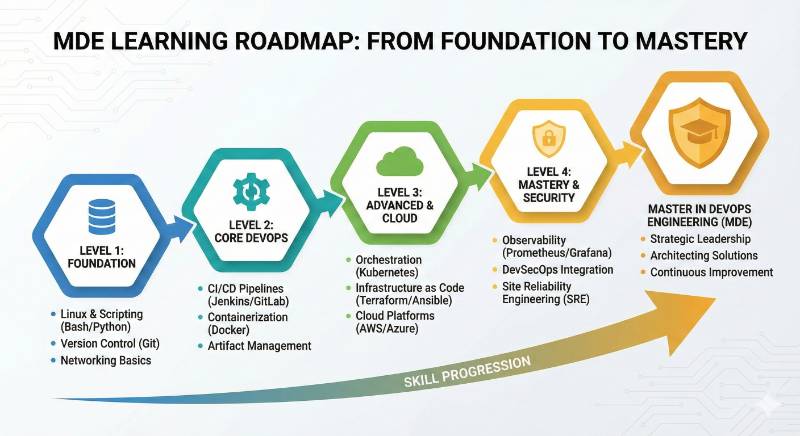
Introduction
The Master in DevOps Engineering (MDE) certification program has become one of the most sought-after qualifications for professionals in the field of DevOps, software engineering, and IT operations. This comprehensive certification prepares individuals to excel in implementing and managing DevOps practices across a wide range of industries. In this guide, we’ll explore everything you need to know about the MDE certification program, from who it is for, to the skills you will gain, and how to succeed in it.
This program is designed for both engineers and managers in DevOps and related fields who want to build advanced skills, enhance their careers, and drive improvements in their organization’s software development and operational processes.
About the Provider
The Master in DevOps Engineering (MDE) certification is offered by DevOpsSchool, a globally recognized provider of professional DevOps, Cloud, Security, and modern IT certifications and training programs.
DevOpsSchool focuses on real-world skills, hands‑on projects, and practical knowledge rather than purely theoretical learning. Their certifications are geared toward working professionals — from engineers to managers — and are designed to help candidates demonstrate industry‑ready capabilities that employers value.
What is the Master in DevOps Engineering (MDE) Certification?
The Master in DevOps Engineering (MDE) is an advanced-level certification designed to help professionals in the IT industry gain a deep understanding of DevOps principles and practices. This certification is perfect for those looking to enhance their skills in the key aspects of DevOps, such as continuous integration, continuous deployment, automation, infrastructure as code (IaC), and cloud platforms.
By completing the MDE certification, you’ll be able to optimize your development processes, automate repetitive tasks, and manage scalable infrastructure in cloud environments. You’ll also gain the expertise needed to streamline collaboration between development and operations teams.
Who Should Take the MDE Certification?
The MDE certification is ideal for:
- Software Engineers: Those who are already working in software development and want to enhance their skills by integrating DevOps principles into their workflow.
- DevOps Engineers: Engineers who are looking to formalize their knowledge of DevOps and take their expertise to the next level.
- Engineering Managers: Managers who are responsible for overseeing software development and IT operations teams, and want to learn how to implement DevOps strategies in their organizations.
- Platform Engineers: Individuals managing the infrastructure and platform development within an organization.
- Cloud Engineers: Those who work with cloud services and want to improve their infrastructure deployment and maintenance skills with a DevOps approach.
Skills You’ll Gain from the MDE Certification
After completing the MDE certification program, you’ll gain expertise in:
- Automating software deployment pipelines using CI/CD tools.
- Managing cloud infrastructure with tools like Terraform, AWS, and Azure.
- Building and maintaining infrastructure as code (IaC).
- Collaborating effectively between development and operations teams.
- Optimizing performance, security, and scalability in a DevOps environment.
- Implementing microservices and containerization using Docker and Kubernetes.
- Managing configuration management tools like Ansible, Chef, and Puppet.
- Implementing monitoring and logging practices using tools like Prometheus and ELK Stack.
Real-World Projects You Should Be Able to Do After the MDE Certification
Once you’ve completed the certification, you should be able to work on projects such as:
- Designing and deploying a CI/CD pipeline for automated software deployment.
- Building and managing scalable cloud infrastructure for web applications.
- Automating infrastructure provisioning using tools like Terraform.
- Implementing container orchestration with Kubernetes in a production environment.
- Creating and managing monitoring solutions for infrastructure health and performance.
Preparation Plan for MDE Certification
A well-structured preparation plan is key to succeeding in the Master in DevOps Engineering (MDE) certification exam. The timeline below offers three stages depending on how much time you can dedicate to studying: a 7–14 day plan, a 30-day plan, and a more thorough 60-day plan.
7–14 Days Preparation Plan
- Week 1: Focus on the basics of DevOps, version control (Git), and continuous integration.
- Week 2: Learn about cloud infrastructure (AWS, Azure), containerization (Docker), and deployment automation tools (Jenkins, Terraform).
30-Day Preparation Plan
- Week 1–2: Deep dive into cloud platforms, containerization, and IaC tools.
- Week 3: Focus on CI/CD pipelines and automation practices.
- Week 4: Practice with real-world projects and build a portfolio.
60-Day Preparation Plan
- Week 1–2: Learn DevOps fundamentals, version control, and monitoring practices.
- Week 3–4: Dive into CI/CD tools, automation scripts, and cloud service providers.
- Week 5–6: Build a full-fledged DevOps pipeline and work with containers and Kubernetes.
Common Mistakes to Avoid
- Skipping Hands-on Practice: Theory alone is not enough. Make sure to practice with tools and projects.
- Overcomplicating Your Pipeline: Keep your CI/CD pipeline simple and efficient rather than over-engineered.
- Neglecting Security: Security should be integrated at every stage of the DevOps pipeline. Don’t ignore security practices.
- Not Staying Updated: DevOps is an evolving field. Always stay updated with the latest tools and technologies.
Best Next Certification After the MDE
- Same Track: Certified DevOps Professional (CDP)
- Cross-Track: Certified Kubernetes Administrator (CKA)
- Leadership Track: Certified DevOps Leader (CDL)
Choose Your Path: DevOps Learning Paths
Based on your career goals and interests, here are six learning paths you can follow after completing the MDE certification:
- DevOps: Mastering key DevOps tools and techniques to automate and streamline the software development lifecycle.
- DevSecOps: Integrating security within the DevOps pipeline to ensure secure, compliant, and efficient operations.
- Site Reliability Engineering (SRE): Enhancing the reliability, availability, and scalability of systems using engineering best practices.
- AIOps/MLOps: Leveraging machine learning and artificial intelligence to automate IT operations and optimize DevOps processes.
- DataOps: Focusing on the automation and management of data pipelines to ensure fast, accurate, and scalable data operations.
- FinOps: Optimizing cloud financial management, aligning engineering teams with cost management strategies in the cloud.
Role → Recommended Certifications
| Role | Recommended Certifications |
|---|---|
| DevOps Engineer | MDE, CDP, CKA |
| Site Reliability Engineer | MDE, SRE, CKA |
| Platform Engineer | MDE, CKA, CKAD |
| Cloud Engineer | MDE, AWS Certified Solutions Architect |
| Security Engineer | MDE, DevSecOps, CISM |
| Data Engineer | MDE, DataOps, Google Professional Data Engineer |
| FinOps Practitioner | MDE, FinOps, Certified Cloud Financial Professional |
| Engineering Manager | MDE, CDL, DevOps Leader |
General FAQs
- What is DevOps, and why is it important?
DevOps is a set of practices that combines software development (Dev) and IT operations (Ops). It emphasizes collaboration, automation, and continuous integration to shorten development cycles and improve product quality. - How do I get started with DevOps?
Start by gaining a solid understanding of software development, version control systems like Git, cloud platforms, and automation tools. Then, explore learning resources, attend courses, and participate in hands-on labs and projects. - What is the role of a DevOps Engineer?
A DevOps Engineer is responsible for automating and managing the deployment pipeline, ensuring continuous integration, and maintaining infrastructure for scalable applications. They bridge the gap between development and operations teams. - What skills should a DevOps Engineer have?
Key skills include experience with cloud platforms (AWS, Azure), automation tools (Jenkins, Terraform), containerization (Docker), configuration management (Ansible, Chef), and monitoring (Prometheus, Grafana). - How do DevOps practices affect software quality?
DevOps practices help improve software quality by automating testing and deployment, ensuring faster delivery with fewer errors, and allowing for continuous feedback and improvement throughout the development lifecycle. - What is Continuous Integration (CI) and Continuous Deployment (CD)?
CI/CD is a DevOps practice that involves automatically building, testing, and deploying applications as new code is committed. This ensures that the latest version of the software is always tested and ready for deployment. - How do DevOps Engineers work with software developers and IT operations teams?
DevOps Engineers collaborate closely with developers to streamline the development and testing process, and with operations teams to ensure smooth deployment and scaling of applications. - What are the best DevOps tools to learn?
Some of the best tools to learn are Jenkins, Docker, Kubernetes, Git, Terraform, Ansible, Prometheus, and AWS. These tools help with CI/CD, containerization, automation, infrastructure as code, and monitoring. - What are the career opportunities after completing a DevOps certification
After completing a DevOps certification, you can pursue roles like DevOps Engineer, Site Reliability Engineer (SRE), Cloud Engineer, Platform Engineer, or Automation Engineer. - How does DevOps improve business outcomes?
DevOps improves business outcomes by reducing development cycles, increasing the speed of delivery, enhancing product quality, and enabling faster response times to market demands. - What challenges might I face in DevOps adoption?
Challenges include resistance to change, lack of collaboration between teams, difficulty in integrating legacy systems, and ensuring proper security practices within the DevOps pipeline. - What is the difference between DevOps and Agile?
While both aim to improve software development efficiency, Agile focuses on iterative development cycles and continuous feedback, while DevOps emphasizes automation, collaboration, and faster deployment cycles across the entire development and operations lifecycle.
FAQs on Master in DevOps Engineering (MDE) Certification
- How difficult is the MDE certification?
The MDE certification is advanced, requiring knowledge of core DevOps concepts, tools, and techniques. It is challenging, but with the right preparation and hands-on practice, it is achievable. - What are the prerequisites for the MDE certification?
A foundational understanding of software engineering, version control, and basic cloud platforms like AWS or Azure is required. Some experience in DevOps tools and processes is also helpful. - How long will it take to complete the MDE certification?
Typically, completing the MDE certification takes 1-2 months of focused study and practice, depending on your experience level and the time you can commit to learning. - What is the exam format for the MDE certification?
The exam typically consists of multiple-choice questions, case studies, and practical scenarios where you must demonstrate your knowledge and skills in DevOps tools, practices, and methodologies. - What topics are covered in the MDE certification?
Key topics include Continuous Integration and Continuous Deployment (CI/CD), Infrastructure as Code (IaC), cloud platforms (AWS, Azure), containerization (Docker, Kubernetes), automation tools (Jenkins, Terraform), and monitoring practices. - Do I need to have previous DevOps experience to take the MDE certification?
While prior DevOps experience is not mandatory, having a basic understanding of DevOps concepts, cloud computing, and automation tools will be highly beneficial. - What kind of real-world skills will I gain from the MDE certification?
You will learn to build CI/CD pipelines, automate infrastructure, manage cloud environments, implement containerization, and troubleshoot issues in production environments, among other real-world skills. - How much time should I dedicate each day to prepare for the MDE exam?
A commitment of 1-2 hours a day is ideal for a balanced approach. However, you may need to adjust this based on your schedule and prior knowledge.
Top Institutions Offering MDE Certification
Here are some top institutions providing training and certification for Master in DevOps Engineering (MDE):
- DevOpsSchool:
Offers comprehensive training with hands-on projects, live sessions, and expert instructors. - Cotocus:
Provides DevOps and cloud certification training with a focus on real-world application. - ScmGalaxy:
Known for in-depth training programs that cover all essential DevOps tools and methodologies. - BestDevOps:
Offers practical DevOps training for professionals looking to improve their skills. - DevSecOpsSchool:
Specialized in integrating security into DevOps practices for a more secure workflow. - SRESchool:
Focuses on Site Reliability Engineering alongside DevOps principles. - AIOpsSchool:
Specializes in integrating AI into DevOps for smarter infrastructure management. - DataOpsSchool:
Offers training on managing data pipelines and workflows in a DevOps environment. - FinOpsSchool:
Provides training on financial management in cloud environments, perfect for FinOps practitioners.
Conclusion
The Master in DevOps Engineering (MDE) certification is a powerful tool to advance your career in DevOps, Cloud Engineering, Site Reliability Engineering (SRE), and related fields. As the IT industry continues to evolve, DevOps has become an essential practice that bridges the gap between software development and IT operations, driving faster and more efficient delivery of high-quality software.
By earning the MDE certification, you’ll gain the hands-on skills needed to implement DevOps practices effectively in real-world scenarios, from automating pipelines and managing cloud infrastructure to deploying scalable applications with Docker and Kubernetes. Whether you’re looking to improve your skills as a DevOps engineer or aiming for a leadership position in your organization, the MDE certification provides the knowledge and credibility you need to excel.
