
Introduction
Cloud computing has changed everything about how we build and run software. If you work in tech today, whether as a developer or a manager, you probably know that simply “knowing how to code” isn’t enough anymore. You need to understand how the whole system fits together.
The AWS Certified Solutions Architect – Associate is a program that teaches you exactly that. It is a way to prove that you know how to build systems on Amazon Web Services (AWS) that are safe, fast, and don’t cost too much money. Think of it as moving from being someone who just lays bricks to someone who knows how to design the whole building.
In this guide, I want to share a clear path for you to master this certification. Having seen how systems fail and succeed over a long time, I can tell you that the lessons you learn here are the foundations of a solid career. We will skip the confusing talk and get straight to what matters: how to pass the exam, what skills you will actually use at work, and how this helps you grow into roles like DevOps, SRE, or Cloud Engineering.
Why AWS Certification Matters in Today’s Landscape
The cloud ecosystem is dynamic, and AWS continues to dominate a significant portion of it. Certifications provide a structured way to validate your skills, opening doors to new opportunities and ensuring you’re equipped to handle modern cloud challenges. For architects, this specific certification confirms your ability to design resilient, performant, secure, and cost-optimized solutions.
Who should take it:
- Developers and engineers looking to move into or strengthen their cloud architecture skills.
- System administrators transitioning to cloud operations.
- Existing solutions architects without prior AWS-specific certification.
- Technical managers who need to understand AWS architectural principles to guide their teams effectively.
Skills you’ll gain:
- Designing and deploying scalable, highly available, and fault-tolerant systems on AWS.
- Understanding the appropriate use of various AWS services based on architectural requirements.
- Implementing security controls and hardening systems on AWS.
- Estimating AWS costs and identifying cost-control mechanisms.
- Deploying and managing data storage solutions.
- Understanding network technologies on AWS.
- Identifying and implementing operational excellence best practices.
Real-world projects you should be able to do after it:
- Designing a highly available web application architecture using EC2, Auto Scaling, and Elastic Load Balancing.
- Setting up a serverless data processing pipeline using S3, Lambda, and DynamoDB.
- Migrating an on-premises application to AWS, including database and storage considerations.
- Designing a secure and isolated network environment using VPC and security groups.
- Proposing cost-optimized solutions for various application workloads on AWS.
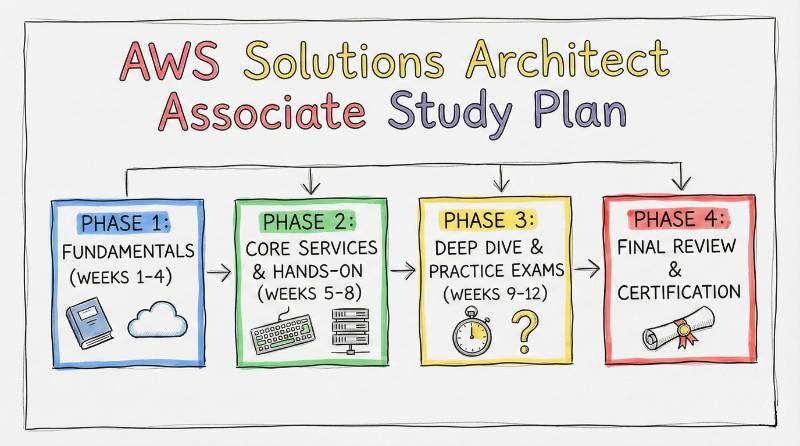
Preparation plan:
- 7-14 days (Intensive Review):
This path is suitable for those with significant prior AWS hands-on experience (6 months to a year) and a strong understanding of core services. Focus on practice exams, reviewing whitepapers (Well-Architected Framework), and solidifying understanding of edge cases and best practices. Dedicate 4-6 hours daily. - 30 days (Focused Study):
Ideal for engineers with some AWS exposure but needing structured learning. Allocate 2-3 hours daily. Combine a good video course with hands-on labs (e.g., building common architectures like a 3-tier web app). Dedicate weekends to comprehensive practice exams and detailed review of incorrect answers. - 60 days (Comprehensive Learning):
Recommended for those relatively new to AWS or those who prefer a slower, more in-depth approach. Dedicate 1-2 hours daily. Start with foundational AWS concepts, gradually moving to service-specific deep dives. Integrate labs regularly, and aim for weekly practice quizzes. Review official documentation and FAQs extensively.
Common mistakes:
- Underestimating the breadth of services: The exam covers a wide range, not just deep dives into a few.
- Focusing only on theoretical knowledge: Hands-on experience is crucial for understanding how services interact.
- Not understanding the Well-Architected Framework: This is the bedrock of AWS best practices and heavily tested.
- Ignoring cost optimization and security: These are fundamental pillars and frequently appear in scenario questions.
- Rushing through practice exams: Analyze why answers are correct or incorrect.
Best next certification after this:
For further specialization, consider the AWS Certified Solutions Architect – Professional for deeper architectural challenges, or the AWS Certified Developer – Associate if you’re keen on application development on AWS. If operations are your focus, the AWS Certified SysOps Administrator – Associate is a logical next step.
Choose Your Path: Specializations Built on AWS Architect Foundations
The AWS Certified Solutions Architect – Associate provides a strong base, but the cloud domain offers diverse specialization paths. Here’s how this certification can launch you into different critical areas of modern tech.
1. DevOps Path
- Focus: Bridging development and operations to automate software delivery and infrastructure management.
- How SAA helps: Provides the architectural understanding of AWS services like EC2, S3, RDS, VPC, and IAM, which are fundamental to building automated CI/CD pipelines and managing infrastructure as code.
- Key skills developed: Infrastructure as Code (CloudFormation/Terraform), CI/CD (CodePipeline/CodeBuild), containerization (ECS/EKS), monitoring (CloudWatch).
2. DevSecOps Path
- Focus: Integrating security practices throughout the entire software development lifecycle, from design to deployment and operations.
- How SAA helps: Develops a strong understanding of AWS security services (IAM, Security Groups, NACLs, KMS, WAF) and the Well-Architected Framework’s security pillar, essential for building secure by design systems.
- Key skills developed: Threat modeling, security automation, compliance as code, incident response in cloud.
3. SRE (Site Reliability Engineering) Path
- Focus: Applying software engineering principles to operations, ensuring reliability, scalability, and efficiency of large-scale systems.
- How SAA helps: Builds expertise in designing resilient and fault-tolerant architectures, crucial for maintaining high availability and disaster recovery strategies using services like Route 53, ALB, Auto Scaling, and multi-AZ deployments.
- Key skills developed: SLIs/SLOs/SLAs, incident management, observability, performance tuning.
4. AIOps/MLOps Path
- Focus: Using AI/Machine Learning to automate IT operations (AIOps) or managing the lifecycle of machine learning models (MLOps).
- How SAA helps: Familiarity with AWS data storage (S3, RDS, DynamoDB) and compute services (EC2, Lambda) is vital for setting up data pipelines and deploying ML models. Understanding networking and security for ML workloads is also covered.
- Key skills developed: Data pipeline design, model deployment, monitoring ML systems, ethical AI considerations.
5. DataOps Path
- Focus: Streamlining the end-to-end data lifecycle, from ingestion and processing to analysis and delivery, with an emphasis on automation and collaboration.
- How SAA helps: The certification provides knowledge of key AWS data services like S3 for data lakes, RDS/DynamoDB for transactional data, and analytics services like Kinesis and Redshift, all necessary for building robust data platforms.
- Key skills developed: Data governance, data quality, data pipeline automation, data warehousing.
6. FinOps Path
- Focus: Bringing financial accountability to the variable spend model of cloud, enabling organizations to make business trade-offs between speed, cost, and quality.
- How SAA helps: The cost optimization pillar of the Well-Architected Framework and understanding of billing and pricing models covered in the SAA exam directly support FinOps practices. It helps identify cost-effective architectural choices.
- Key skills developed: Cloud cost management, budget forecasting, resource tagging, rightsizing, reserved instances/savings plans.
Role → Recommended Certifications
Matching certifications to roles helps clarify career progression and skill validation. Here’s a pragmatic mapping:
- DevOps Engineer:
- AWS Certified Solutions Architect – Associate (Foundational)
- AWS Certified Developer – Associate
- AWS Certified SysOps Administrator – Associate
- AWS Certified DevOps Engineer – Professional
- SRE (Site Reliability Engineer):
- AWS Certified Solutions Architect – Associate (Foundational)
- AWS Certified SysOps Administrator – Associate
- AWS Certified DevOps Engineer – Professional
- Platform Engineer:
- AWS Certified Solutions Architect – Associate (Foundational)
- AWS Certified Developer – Associate
- AWS Certified DevOps Engineer – Professional
- Cloud Engineer:
- AWS Certified Solutions Architect – Associate (Core)
- AWS Certified SysOps Administrator – Associate
- AWS Certified Advanced Networking – Specialty
- Security Engineer:
- AWS Certified Solutions Architect – Associate (Foundational for cloud context)
- AWS Certified Security – Specialty
- AWS Certified Advanced Networking – Specialty
- Data Engineer:
- AWS Certified Solutions Architect – Associate (Foundational for data platform design)
- AWS Certified Database – Specialty
- AWS Certified Data Analytics – Specialty
- FinOps Practitioner:
- AWS Certified Solutions Architect – Associate (Essential for understanding cost implications of architecture)
- AWS Certified Cloud Practitioner (Optional, for broader cloud context)
- Engineering Manager:
- AWS Certified Solutions Architect – Associate (Highly Recommended for strategic oversight)
- AWS Certified Cloud Practitioner
- Any Associate-level certification relevant to their team’s primary cloud focus.
Next Certifications to Take After AWS Certified Solutions Architect – Associate
Once you’ve conquered the Associate Solutions Architect certification, you have several excellent avenues for continued growth.
- Same Track Deep Dive: AWS Certified Solutions Architect – Professional
- Why: This is the natural progression if you want to become a true master architect. It challenges you with highly complex, multi-account, hybrid, and advanced architectural scenarios, pushing your design skills to their limits.
- Skills Reinforced/Gained: Advanced networking, complex migrations, multi-account strategy, governance, business continuity, and disaster recovery.
- Cross-Track Specialization: AWS Certified DevOps Engineer – Professional
- Why: If your interests lean heavily into automation, continuous delivery, and operational excellence, this is a fantastic complement. It bridges the gap between architecture design and its efficient, automated implementation.
- Skills Reinforced/Gained: CI/CD pipelines, infrastructure as code, monitoring and logging at scale, incident and event management.
- Leadership & Strategic Focus: AWS Certified Security – Specialty
- Why: For those moving into leadership or more specialized security roles, understanding how to secure complex AWS environments is paramount. This deep dive into security services and best practices is invaluable for guiding teams and safeguarding cloud assets.
- Skills Reinforced/Gained: Data protection, incident response, network security, identity and access management, security operations.
Top Institutions for AWS Certified Solutions Architect – Associate Training
Finding the right training partner can significantly enhance your preparation. Here are some institutions known for providing comprehensive training and certification support:
- DevOpsSchool:
This institution specializes in a broad range of DevOps and cloud-native training programs. Their approach often includes practical, hands-on labs and real-world scenarios, making them a strong choice for those who learn by doing and want to apply AWS architecture directly to DevOps practices. - Cotocus:
Cotocus is known for its intensive, expert-led training sessions across various cloud and IT domains. They often focus on a blend of theoretical knowledge and practical implementation, providing detailed study materials and guided lab sessions crucial for understanding complex AWS architectural patterns. - Scmgalaxy:
Scmgalaxy provides specialized training for various IT certifications, including a strong emphasis on cloud technologies. Their programs are typically structured to cover all exam objectives thoroughly, often with a focus on helping candidates grasp both the foundational and advanced aspects of AWS architecture. - BestDevOps:
As the name suggests, BestDevOps is dedicated to high-quality training in DevOps and related cloud fields. Their AWS Solutions Architect – Associate program is designed to equip engineers with the practical skills and theoretical knowledge needed to confidently design and deploy scalable solutions on AWS. - devsecopsschool.com:
Focusing on the critical intersection of development, security, and operations, devsecopsschool.com offers training that integrates security best practices directly into architectural design. This makes their AWS SAA training particularly valuable for those aiming for secure cloud deployments. - sreschool.com:
For those with an SRE mindset, sreschool.com provides training that emphasizes reliability, scalability, and operational efficiency in AWS architectures. Their SAA program would likely highlight the architectural decisions that lead to highly resilient and performant systems. - aiopsschool.com:
Specializing in Artificial Intelligence for IT Operations, aiopsschool.com might integrate aspects of data handling and machine learning infrastructure into their AWS SAA training. This is beneficial for architects looking to support AI/ML workloads on AWS. - dataopsschool.com:
This institution focuses on streamlining data pipelines and management. Their AWS SAA training would likely emphasize architectural considerations for data storage, processing, and analytics services, essential for building robust data platforms on AWS. - finopsschool.com:
For those interested in the financial aspects of cloud, finopsschool.com would likely incorporate a strong focus on cost optimization and financial governance within their AWS SAA training, helping architects design cost-effective cloud solutions from the ground up.
Frequently Asked Questions (FAQs) about AWS Certified Solutions Architect – Associate
Here are answers to common questions about the AWS Certified Solutions Architect – Associate certification.
1. How difficult is the AWS Certified Solutions Architect – Associate exam?
The exam is moderately difficult. It requires not just memorization but a deep understanding of how various AWS services interact and how to apply them to real-world architectural scenarios. Many find the breadth of services covered challenging.
2. How much time do I need to prepare for the exam?
Preparation time varies greatly depending on your existing AWS knowledge and hands-on experience. Beginners might need 60-90 days of dedicated study (1-2 hours daily), while those with some hands-on experience might be ready in 30 days. Intensive preparation for experienced individuals can be as short as 7-14 days.
3. Are there any strict prerequisites for taking the exam?
AWS recommends at least six months of hands-on experience with AWS, but there are no strict prerequisites to register for the exam. However, attempting it without practical experience or solid theoretical understanding significantly reduces your chances of passing.
4. Is there a recommended sequence for AWS certifications?
Yes, generally, it’s recommended to start with the Cloud Practitioner, then move to an Associate-level certification like Solutions Architect. From there, you can specialize with Professional or Specialty certifications.
5. What is the value of getting this certification?
This certification validates your ability to design robust and scalable solutions on AWS, making you a more valuable asset in the cloud job market. It opens doors to new career opportunities, can lead to higher salaries, and provides a structured understanding of AWS best practices.
6. What kind of career outcomes can I expect after achieving this certification?
You’ll be well-positioned for roles like Cloud Engineer, AWS Solutions Architect, Cloud Consultant, or even moving into leadership positions where understanding cloud architecture is crucial. It also enhances your credibility in existing roles.
7. Is hands-on experience truly necessary, or can I just study the theory?
Hands-on experience is critical. The exam questions often present scenarios that require you to think like an architect and apply your knowledge practically. Without practical exposure, it’s hard to truly grasp the nuances of service interactions and limitations.
8. Does this certification expire? How do I renew it?
Yes, AWS certifications are valid for three years. To maintain your certification, you must retake the current exam, or pass a Professional-level or Specialty exam on the same track, or complete certain continuing education activities within the three-year window.
FAQs (Frequently Asked Questions)
1. How difficult is the SAA-C03 exam compared to others?
It is a medium-difficulty exam. It requires a solid understanding of how different AWS services interact rather than just knowing what a single service does. It is harder than the Cloud Practitioner but more manageable than the Professional level.
2. How much time do I need to prepare?
For a working professional, 4-6 weeks of consistent study (1-2 hours a day) is usually enough to pass. If you are brand new to the cloud, you might want to give yourself 8–10 weeks.
3. Are there any mandatory prerequisites?
No, there are no formal prerequisites. You can take this exam even if you haven’t passed the Cloud Practitioner. However, having 6 months of hands-on AWS experience is very helpful.
4. What is the recommended sequence for AWS certifications?
Most people start with Cloud Practitioner (optional), move to Solutions Architect Associate, and then choose either the Developer Associate or SysOps Associate before jumping to the Professional level.
5. Is this certification worth it for a Software Engineer? Absolutely. Modern software is cloud-native. Understanding architecture helps you write better, more scalable code and understand where your code actually lives and how it scales.
6. Can I take the exam from home?
Yes, AWS offers online proctored exams through Pearson VUE, allowing you to take the test from your home or office.
7. How long is the certification valid?
It is valid for 3 years. You can recertify by taking the Professional level exam or retaking the Associate exam.
8. Does this certification help in getting a job in India? Y
es, AWS is the market leader in India. This certification is one of the most recognized credentials by top MNCs, service-based companies, and startups.
9. What is the passing score for SAA-C03?
The exam is scored from 100 to 1,000. You need a minimum score of 720 to pass.
10. What is the most important service to study for the exam?
VPC (Networking) and EC2/S3 (Compute/Storage) are the core pillars. If you master these three, you have a very strong chance of passing.
11. Can I skip the Associate level and go straight to Professional?
While AWS allows this, it is not recommended. The Professional exam is significantly harder and assumes you have already mastered everything in the Associate syllabus.
12. What are the career outcomes after getting this certification?
It opens doors to roles such as Cloud Architect, Systems Engineer, and Senior Developer. It also provides the foundation needed to transition into specialized fields like DevOps, SRE, or Cloud Security.
Conclusion
The AWS Certified Solutions Architect – Associate is more than just a certificate for your resume; it is a fundamental shift in how you look at building software. In my experience, the gap between a good engineer and a great one is often their ability to see the “big picture”—understanding how data flows, where bottlenecks happen, and how to keep a system running when things go wrong.
Whether you are in India or working with a global team, the cloud is the common language of modern infrastructure. By mastering the Well-Architected Framework, you aren’t just learning AWS; you are learning the principles of robust engineering that will serve you for a long time. Start with the basics, get your hands dirty in the console, and don’t be afraid to break things in a sandbox environment. That is where the real learning happens.
