
Introduction
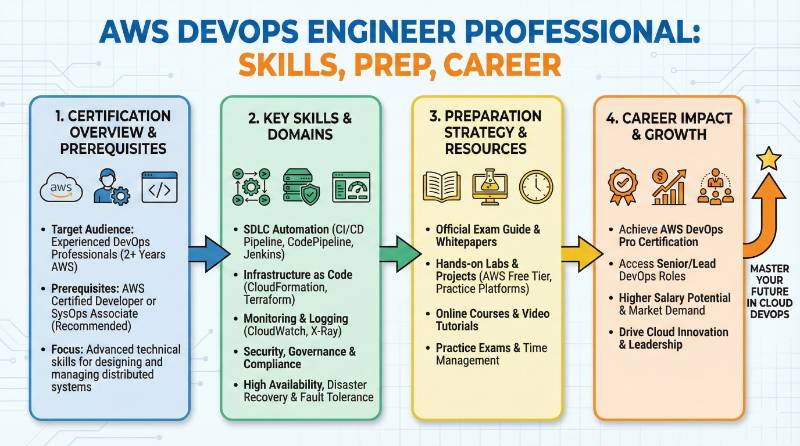
The AWS Certified DevOps Engineer – Professional certification stands as one of the most respected and challenging credentials in the cloud industry, validating your ability to automate, orchestrate, and operate complex workloads on AWS at enterprise scale. This comprehensive guide cuts through the noise to deliver everything working engineers and managers need to know—from exam prerequisites and preparation strategies to real-world skills you’ll gain and career paths you can pursue.
Whether you’re an experienced DevOps practitioner aiming to validate your expertise, an SRE looking to formalize your reliability engineering knowledge, or an engineering manager guiding your team’s professional development, this guide provides practical insights drawn from years of hands-on experience architecting and managing production systems across diverse industries. No fluff, no theory without context—just actionable information to help you understand, prepare for, and leverage this powerful certification throughout your career journey.
What Is the AWS DevOps Engineer – Professional Certification?
The AWS Certified DevOps Engineer – Professional (DOP-C02) is an advanced-level certification that validates your expertise in provisioning, operating, and managing distributed application systems on AWS. Unlike associate-level exams, this one focuses heavily on automation, continuous delivery, infrastructure as code, and operational excellence at scale.
This certification proves you can bridge the gap between development and operations, automate complex workflows across multiple accounts and regions, and design resilient systems that enterprises rely on every single day. It’s not just about knowing AWS services—it’s about knowing how to make them work together seamlessly in production environments.
Who Should Take This Certification?
This certification is designed specifically for:
- DevOps engineers with 2+ years of hands-on AWS experience managing production workloads
- Site Reliability Engineers (SREs) responsible for service reliability, observability, and incident response
- Cloud architects designing automated solutions for complex enterprise environments
- Senior system administrators transitioning into modern DevOps practices
- Platform engineers building internal developer platforms and self-service capabilities
- Release engineers managing deployment pipelines across multiple applications and teams
If you’re already comfortable with core AWS services and want to validate your automation and operational expertise, this certification is your next logical step. It’s not for beginners—it’s for practitioners ready to prove they can handle real-world complexity.
Skills You’ll Gain
After earning this certification, you’ll have demonstrated proficiency in:
- CI/CD automation – Designing and implementing end-to-end pipelines using AWS CodeCommit, CodeBuild, CodeDeploy, and CodePipeline across multiple environments
- Infrastructure as Code (IaC) – Authoring complex CloudFormation templates, using AWS CDK, and managing infrastructure dependencies at scale
- Configuration management – Automating system configurations with AWS Systems Manager, OpsWorks, and integrating third-party tools like Chef and Puppet
- Monitoring and observability – Implementing comprehensive monitoring with CloudWatch, Container Insights, X-Ray tracing, and centralized logging solutions
Real-World Projects You Should Be Able to Do After It
This certification isn’t theoretical. After earning it, you should confidently handle:
- Build a complete CI/CD pipeline that deploys a microservices application across development, staging, and production accounts with automated testing, security scanning, and approval gates
- Automate the creation of a secure, multi-account AWS environment using AWS Control Tower, Customizations for Control Tower, and Service Control Policies that enforce governance
- Implement blue/green and canary deployments for a containerized application on Amazon EKS with zero downtime and automatic rollback on failure
- Design an automated incident response system that detects EC2 instance failures, captures diagnostic data, replaces the instance, and notifies the team—all without human intervention
Preparation Plan
7–14 Days (Rapid Review)
Perfect for experienced professionals who need a quick refresh before exam day:
- Days 1–3: Take a diagnostic practice exam to identify weak areas. Review exam domains and official guide.
- Days 4–7: Focus intensely on your weakest domains. Use AWS documentation and hands-on practice.
- Days 8–10: Deep dive into AWS Systems Manager, CloudFormation, CodePipeline, and monitoring services.
- Days 11–14: Take full-length practice exams daily. Review every incorrect answer until you understand why the correct answer is right and others are wrong.
This works only if you already have 2+ years of daily AWS hands-on experience.
30 Days (Balanced Approach)
Ideal for working professionals with solid experience but need structured review:
- Week 1: Complete domain review of SDLC Automation (22% of exam) and Configuration Management (19% of exam). Build a simple CI/CD pipeline.
- Week 2: Focus on Resilient Cloud Solutions (15% of exam) and Monitoring & Logging (15% of exam). Implement comprehensive monitoring for a sample application.
- Week 3: Master Incident Response (11% of exam) and Security & Compliance (18% of exam). Automate incident response for common failure scenarios.
- Week 4: Practice exams, hands-on labs, and targeted review of weak areas. Take at least 3 full-length practice exams.
60 Days (Thorough Preparation)
Recommended if you’re newer to advanced AWS concepts or want to build deeper expertise:
- Weeks 1–2: Build strong foundation in core AWS services. Review associate-level concepts. Get comfortable with CLI and basic automation.
- Weeks 3–4: Deep dive into each exam domain with hands-on projects. Build complete pipelines. Master CloudFormation.
- Week 5: Implement real-world projects matching exam scenarios. Break and fix things intentionally to understand failure modes.
- Week 6–8: Practice exams, review documentation, fill knowledge gaps. Take at least 5 full-length practice exams under timed conditions.
Remember: This exam tests practical application. Reading alone won’t get you there. You must build, break, and fix.
Common Mistakes to Avoid
- Skipping hands-on practice entirely – Reading documentation isn’t enough. You need to build things with your own hands.
- Memorizing instead of understanding – Questions are complex scenarios. You must apply concepts, not recite facts.
- Ignoring AWS Systems Manager – It appears throughout the exam across multiple domains. Master SSM Documents, Automation, Run Command, and Patch Manager.
- Underestimating multi-account scenarios – Be comfortable with cross-account automation, roles, and resource sharing using AWS Organizations.
- Neglecting security integration – Security isn’t a separate domain; it’s embedded in every aspect of DevOps. Think security first.
Best Next Certification After This
Same Track (Deepen DevOps Expertise)
- AWS Certified Solutions Architect – Professional – Complements DevOps expertise with advanced architecture skills for enterprise-scale design and migration
Cross-Track (Expand Your Horizons)
- AWS Certified Security – Specialty – Deepen your security automation capabilities and master IAM, encryption, and compliance at scale
- Certified Kubernetes Administrator (CKA) – Broaden your container orchestration expertise beyond Amazon EKS
Leadership Track (Strategic Growth)
- HashiCorp Certified: Terraform Associate – Deepen your infrastructure as code capabilities with the industry-standard tool
- AWS Certified Advanced Networking – Specialty – Master complex networking scenarios including hybrid connectivity and advanced VPC design
AWS Certifications Overview Table
| Certification | Track | Level | Who It’s For | Prerequisites | Skills Covered | Recommended Order |
|---|---|---|---|---|---|---|
| AWS Certified Cloud Practitioner | Foundational | Foundational | Beginners, non-technical roles, managers | None | Cloud concepts, billing, pricing models, core services | 1st |
| AWS Certified AI Practitioner | Foundational | Foundational | Beginners exploring AI/ML on AWS | None | AI concepts, Bedrock basics, ML workflow fundamentals | 1st or 2nd |
| AWS Certified Solutions Architect – Associate | Architecture | Associate | Solutions architects, cloud engineers, developers | 1 year AWS experience | EC2, S3, VPC, RDS, IAM, HA architecture, storage | 2nd |
| AWS Certified Developer – Associate | Development | Associate | Developers, DevOps engineers, build engineers | 1 year development experience | Code services, Lambda, API Gateway, DynamoDB, CI/CD basics | 2nd or 3rd |
| AWS Certified SysOps Administrator – Associate | Operations | Associate | SysAdmins, operations engineers, support staff | 1 year operations experience | Deployment, management, monitoring, patching, troubleshooting | 2nd or 3rd |
| AWS Certified Data Engineer – Associate | Data | Associate | Data engineers, analytics professionals, ETL developers | Associate-level knowledge | Data lakes, ETL pipelines, AWS Glue, Lake Formation, Redshift | 3rd |
| AWS Certified Machine Learning Engineer – Associate | AI/ML | Associate | ML engineers, MLOps practitioners | Associate-level knowledge | ML model deployment, SageMaker pipelines, model monitoring | 3rd |
| AWS Certified DevOps Engineer – Professional | DevOps | Professional | DevOps engineers, SREs, platform engineers | 2+ years AWS experience, associate certs recommended | CI/CD, IaC, monitoring, security automation, incident response | 4th |
| AWS Certified Solutions Architect – Professional | Architecture | Professional | Senior architects, enterprise architects | Associate-level certification | Enterprise architecture, migration, hybrid, cost optimization | 4th |
| AWS Certified Security – Specialty | Security | Specialty | Security engineers, compliance officers | 2+ years security experience | IAM advanced, encryption, KMS, WAF, Shield, compliance frameworks | 4th |
| AWS Certified Machine Learning – Specialty | AI/ML | Specialty | Data scientists, ML practitioners | Advanced ML knowledge | ML algorithms, model tuning, SageMaker advanced, deep learning | 5th |
| AWS Certified Advanced Networking – Specialty | Networking | Specialty | Network engineers, cloud network architects | Advanced networking experience | Hybrid networking, VPC advanced, Transit Gateway, DX, BGP | 5th |
| AWS Certified Database – Specialty | Database | Specialty | Database administrators, data architects | 2+ years database experience | RDS, Aurora, DynamoDB, Redshift, database migration, optimization | 5th |
| AWS Certified Data Analytics – Specialty | Data | Specialty | Data analysts, analytics architects | 2+ years analytics experience | Athena, EMR, Redshift, QuickSight, Kinesis, streaming analytics | 5th |
Choose Your Path: 6 Learning Tracks
DevOps Path
Focus on CI/CD automation, infrastructure as code, and operational excellence. Master CodePipeline, CloudFormation, Systems Manager, and comprehensive monitoring. Perfect for automation engineers and release managers who want to streamline software delivery.
DevSecOps Path
Integrate security throughout the DevOps lifecycle. Focus on automated security testing in pipelines, infrastructure compliance as code, IAM automation, and incident response. Essential for organizations embracing “shift left” security practices.
SRE Path
Emphasize reliability, observability, and incident management. Master CloudWatch, X-Ray, ServiceLens, and automated remediation. Learn to define and track Service Level Objectives (SLOs) while balancing feature velocity with system stability.
AIOps/MLOps Path
Combine DevOps with machine learning operations. Focus on automating ML pipelines with SageMaker Pipelines, model deployment strategies, drift detection, and monitoring. Critical for organizations deploying ML models to production.
DataOps Path
Specialize in data pipeline automation and data quality. Master AWS Glue, Lake Formation, Step Functions for data workflows, and automated data quality validation. Essential for data engineers building reliable data platforms.
FinOps Path
Optimize cloud costs through automation and governance. Focus on cost allocation strategies, automated rightsizing, usage optimization, and building cost-aware cultures. Increasingly vital as cloud spending grows across organizations.
Role → Recommended Certifications Mapping
| Role | Primary Certifications | Supporting Certifications |
|---|---|---|
| DevOps Engineer | AWS Certified DevOps Engineer – Professional | AWS Developer – Associate, AWS Security – Specialty, AWS Solutions Architect – Associate |
| Site Reliability Engineer (SRE) | AWS Certified DevOps Engineer – Professional | AWS SysOps – Associate, AWS Advanced Networking – Specialty, AWS Solutions Architect – Professional |
| Platform Engineer | AWS Certified DevOps Engineer – Professional | AWS Solutions Architect – Professional, CKA, AWS Security – Specialty |
| Cloud Engineer | AWS Solutions Architect – Associate | AWS DevOps Engineer – Professional, AWS SysOps – Associate, AWS Security – Specialty |
| Security Engineer | AWS Security – Specialty | AWS DevOps Engineer – Professional, AWS Solutions Architect – Associate, AWS Advanced Networking – Specialty |
| Data Engineer | AWS Data Engineer – Associate | AWS DevOps Engineer – Professional, AWS Data Analytics – Specialty, AWS Machine Learning – Specialty |
| FinOps Practitioner | AWS Certified Cloud Practitioner | AWS Solutions Architect – Associate, AWS DevOps Engineer – Professional, AWS Data Engineer – Associate |
| Engineering Manager | AWS Solutions Architect – Professional | AWS DevOps Engineer – Professional, AWS Security – Specialty, AWS Certified Cloud Practitioner |
Top Training Providers for AWS DevOps Engineer – Professional
DevOpsSchool
DevOpsSchool offers comprehensive instructor-led training for AWS DevOps Engineer – Professional with hands-on labs and real-world projects spanning CI/CD pipelines and infrastructure automation. Their curriculum covers all exam domains with practical exercises that prepare you for both the certification and actual job responsibilities, featuring flexible batch timings for working professionals.
Cotocus
Cotocus provides personalized training programs with flexible scheduling options tailored to individual learning paces and existing experience levels. Their trainers bring 15+ years of industry experience and focus on bridging the gap between theoretical concepts and practical implementation in complex enterprise environments.
Scmgalaxy
Scmgalaxy delivers structured learning paths with extensive hands-on practice across 50+ real-world scenarios simulating production challenges. Their training materials include recorded sessions from past batches, live workshops with Q&A, and mock exams that closely mirror the actual certification experience.
BestDevOps
BestDevOps offers specialized bootcamps designed for working professionals seeking accelerated certification preparation without compromising depth. Their accelerated programs help you master key concepts through weekend and evening batches while providing 24/7 access to lab environments for self-paced practice.
devsecopsschool.com
DevSecOpsSchool focuses specifically on integrating security into DevOps practices with dedicated modules on DevSecOps pipelines and automated compliance. Their training emphasizes automated security controls, compliance as code implementation, and secure pipeline design alongside core DevOps concepts tested in the exam.
sreschool.com
SRESchool specializes in Site Reliability Engineering principles with curriculum aligned to both AWS certification and real-world SRE implementation. Their unique approach emphasizes observability, incident response automation, and reliability engineering practices essential for modern SRE roles beyond basic certification requirements.
aiopsschool.com
AIOpsSchool combines DevOps with AI operations through specialized training on AI-powered monitoring and automated remediation. Their curriculum covers predictive analytics for cloud environments, ML-based anomaly detection, and integrating AI/ML workflows with traditional DevOps practices.
dataopsschool.com
DataOpsSchool focuses on data pipeline automation with comprehensive coverage of AWS data services and automation strategies. Their programs cover data integration, workflow orchestration, automated data quality management, and building reliable data platforms using AWS native tools.
finopsschool.com
FinOpsSchool specializes in cloud financial management with practical training on cost optimization strategies and governance automation. Their curriculum covers automated rightsizing, usage optimization, cost allocation tagging strategies, and building financial accountability across engineering teams.
FAQs: AWS DevOps Engineer – Professional
Difficulty & Time
Q1: How difficult is the AWS DevOps Engineer – Professional exam?
A: It’s widely considered one of the most challenging AWS certifications available today. The difficulty rating is 5/5 due to complex scenario-based questions, lengthy problem statements spanning multiple paragraphs, and answer options that are technically correct but only one is optimal for the specific situation. You need deep understanding of how services interact, not just isolated service knowledge.
Q2: How much time should I dedicate to preparation?
A: Plan for 80–120 hours of focused study spread over 4–8 weeks. This includes reading documentation, hands-on practice building real projects, and taking multiple practice exams. Your actual time depends heavily on your existing AWS experience—someone with 3+ years of daily DevOps work might need only 40–50 hours, while someone newer might need 150+ hours.
Q3: Is hands-on experience absolutely mandatory?
A: Yes, without question. This exam tests practical application in realistic scenarios. You cannot pass by memorizing exam dumps or reading books alone. You need to have built CI/CD pipelines, written CloudFormation templates, configured monitoring, and automated incident response with your own hands. Build things, break them, and fix them.
Prerequisites & Sequence
Q4: What exact prerequisites do I need before attempting this exam?
A: AWS recommends 2+ years of hands-on experience with AWS including experience automating infrastructure and managing production workloads. You should also have strong scripting skills (Python, Bash, or similar) and familiarity with CI/CD concepts. Most successful candidates also hold at least one Associate-level certification, typically Solutions Architect or Developer.
Q5: Should I take Associate certifications before attempting this Professional exam?
A: Yes, absolutely. The exam assumes knowledge covered in Associate certifications and builds upon it. Candidates who skip directly to Professional without Associate-level foundation almost always struggle. The recommended sequence is Solutions Architect – Associate, then Developer – Associate or SysOps – Associate, then DevOps Engineer – Professional.
Q6: Can I take this certification without any prior AWS certification at all?
A: Technically there’s no formal prerequisite requiring prior certifications, but practically it’s highly discouraged. The exam questions assume you understand concepts tested in Associate exams. You’ll face an uphill battle trying to learn both foundational and advanced concepts simultaneously while deciphering complex scenario questions.
Value & Career Outcomes
Q7: Is this certification worth pursuing in today’s job market?
A: Absolutely. DevOps remains one of the highest-demand functions in cloud computing, with increasing focus on automation, security integration, and operational excellence. Certified professionals report higher credibility during interviews, faster promotions, and the ability to command higher salaries. Organizations actively seek this credential when hiring senior DevOps roles.
Q8: What kind of salary impact can I realistically expect?
A: AWS Professional-level certifications consistently rank among top-paying IT certifications in global salary surveys. In India, certified professionals typically see 30-50% salary premiums over non-certified peers. Globally, the differential ranges from 20-40% depending on region and role. Your actual mileage depends on your overall experience and negotiation skills.
Q9: Will this certification help me get international job opportunities?
A: Yes, significantly. AWS certifications are recognized and respected worldwide. Many certified professionals leverage this credential to secure positions in North America, Europe, Southeast Asia, and the Middle East. The certification provides common ground with international employers and demonstrates your commitment to professional standards.
Exam Details & Strategy
Q10: What’s the exact exam format I’ll face?
A: The exam consists of 75 questions to be completed in 180 minutes. Questions are multiple choice and multiple response (select all that apply). Passing score is 750 out of 1000. Questions are heavily scenario-based—you’ll read descriptions of complex situations and need to choose the best combination of services and configurations to solve the problem.
Q11: How much does the exam cost, and are there discounts?
A: The exam costs 300 USD. After passing any AWS certification exam, you receive a 50% discount voucher for your next AWS certification exam. This makes pursuing multiple certifications more affordable. Practice exams through AWS Training Portal cost 40 USD and are highly recommended.
Q12: How long is the certification valid before needing renewal?
A: The certification is valid for 3 years from your exam date. To recertify, you must pass the current version of the AWS Certified DevOps Engineer – Professional exam again. AWS also offers continuing education options through specific courses that can extend certification validity, though the Professional level typically requires exam recertification.
Q13: What languages is the exam available in?
A: The exam is available in English, Japanese, Korean, and Simplified Chinese. If you’re taking the exam in a language other than your native tongue, request extra time accommodation if eligible. The scenario questions are complex enough in your first language—translation adds additional cognitive load.
Q14: Where can I take the exam?
A: You have two options: at Pearson VUE testing centers worldwide, or online proctored from your home or office. Testing centers provide a controlled environment without distractions. Online proctoring offers convenience but requires a stable internet connection, private room, and compliance with strict monitoring requirements.
FAQs on AWS DevOps Engineer – Professional
Q1: What’s the main difference between DevOps Engineer – Professional and Solutions Architect – Professional?
A: DevOps Pro focuses intensely on automation, CI/CD pipelines, configuration management, and operational aspects of running workloads. Solutions Architect Pro focuses on architectural design, migration strategies, enterprise-wide governance, and hybrid architectures. DevOps Pro is about keeping systems running and changing safely; Architect Pro is about designing the systems themselves.
Q2: Which AWS services absolutely must I master for this exam?
A: You must know CodePipeline, CodeBuild, CodeDeploy, CloudFormation, Systems Manager, CloudWatch, Lambda, and IAM inside and out. You should also be comfortable with Elastic Beanstalk, OpsWorks, EC2 auto scaling, Elastic Load Balancing, and Step Functions. For each service, understand not just features but common integration patterns and troubleshooting approaches.
Q3: How many questions should I expect on CI/CD specifically?
A: About 22% of the exam covers SDLC Automation, making it the single largest domain. Expect 15–17 questions focused on CI/CD pipelines, source control integration, build automation, deployment strategies, and testing automation. Master blue/green deployments, canary releases, and rollback strategies thoroughly.
Q4: Is Terraform covered in the exam, and how should I prepare for it?
A: Yes, Terraform appears in the exam, but from an AWS perspective. You need to understand how Terraform integrates with AWS, how to manage state files, and how to use Terraform alongside CloudFormation. However, CloudFormation receives more focus since it’s the native AWS tool. If you know Terraform well, learn CloudFormation equivalents for key concepts.
Q5: How do I effectively handle the extremely long scenario questions?
A: Develop a consistent technique. Read the last sentence first—it tells you what the question actually asks. Then quickly scan the scenario for key details: existing architecture, constraints, requirements, and failure points. Eliminate obviously wrong answers, then evaluate remaining options against the specific requirements. Practice this technique during every mock exam.
Q6: What’s the most effective way to get hands-on practice for this exam?
A: Build complete end-to-end projects, not isolated labs. Create a multi-account CI/CD pipeline deploying a sample application with automated testing. Build CloudFormation templates that create entire environments including networking, compute, and databases. Implement comprehensive monitoring with dashboards and alarms. Set up automated incident response that replaces failed resources. Real projects beat tutorials every time.
Q7: Is using exam dumps from online sources acceptable preparation?
A: Absolutely not. Exam dumps violate AWS certification policies, are often outdated with incorrect answers, and will not teach you the underlying concepts. More importantly, you’ll struggle in technical interviews and on the actual job because you never developed real understanding. Employers can quickly identify candidates who passed through memorization versus those who truly understand DevOps on AWS.
Q8: How do I maintain and renew my certification once earned?
A: Mark your calendar for 3 years from your certification date. AWS typically releases new exam versions before expiration dates. Start preparing 3-6 months before expiry by reviewing what’s changed in AWS services and exam domains. You’ll need to pass the current version of the DevOps Engineer – Professional exam. AWS also offers continuing education programs through specific courses, but recertification by exam remains the most straightforward path.
Conclusion
The AWS Certified DevOps Engineer – Professional certification represents far more than just another credential to add to your resume—it’s a powerful validation of your ability to design, automate, and manage complex cloud systems at enterprise scale. Throughout this guide, we’ve explored everything from exam structure and preparation strategies to real-world skills and career pathways, giving you a complete roadmap for success.
Whether you choose to pursue the DevOps, DevSecOps, SRE, or any other specialized track, remember that this certification serves as both a milestone and a foundation—it confirms your current expertise while opening doors to deeper specialization and leadership opportunities. The cloud landscape continues evolving at breakneck speed, with AI integration, security automation, and platform engineering reshaping how we build and operate systems. By earning this professional-level certification, you’re not just keeping pace with these changes—you’re positioning yourself to lead them.
