
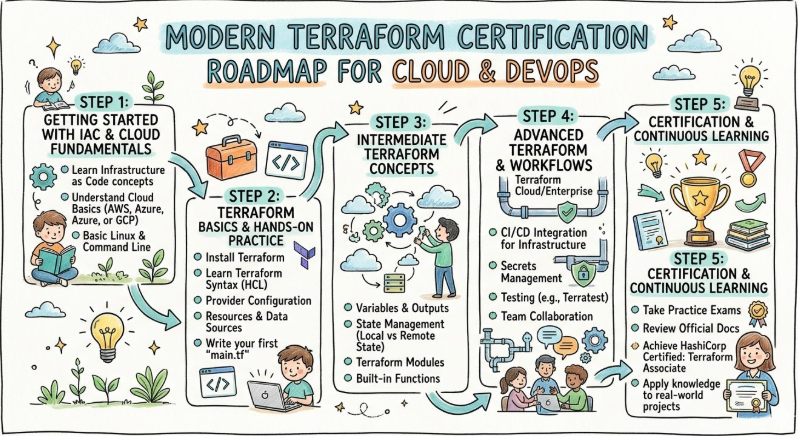
Introduction
HashiCorp Terraform has become a core skill for modern cloud and DevOps teams, moving infrastructure management away from manual clicks toward Infrastructure as Code. By defining your cloud resources in code, you gain repeatability, version control, and safer collaboration across environments like AWS, Azure, and GCP. This shift is now a baseline expectation for roles such as DevOps Engineer, SRE, Platform Engineer, and Cloud Engineer.
HashiCorp Terraform training and certification provide a clear, structured path to build and validate these skills. Through guided learning, hands‑on labs, and a formal exam, you learn how to design, provision, and manage real‑world infrastructure in a reliable and scalable way. For working professionals and managers, earning this certification is a strong signal to employers that you can contribute to modern, automated cloud platforms and drive IaC best practices across teams.
Why Terraform skills matter today
Terraform is the de‑facto standard for Infrastructure as Code (IaC) in many organizations.
It lets teams define cloud infrastructure using code, version it in Git, automate deployments, and keep environments consistent across dev, test, and production.
Key reasons Terraform is so important:
- Cloud‑first and multi‑cloud architectures are now common in enterprises.
- Manual console‑based provisioning does not scale for modern microservices and Kubernetes‑based systems.
- IaC and GitOps practices are now standard expectations for DevOps, SRE, and Platform roles.
A solid Terraform foundation also makes it easier to learn tools like Kubernetes, Helm, and cloud‑native automation stacks.
Overview of HashiCorp Terraform certification
HashiCorp currently offers the Terraform Associate certification as part of its Infrastructure Automation certifications.
This exam validates your fundamental skills with Terraform Community Edition and HCP Terraform, focusing on IaC concepts, Terraform workflow, configuration, modules, state, and cloud integration.
High‑level details:
- Track: Infrastructure as Code / Infrastructure Automation
- Level: Associate (Foundational)
- Exam duration: 1 hour (computer‑based)
- Language: English
- Target audience: Cloud Engineers, DevOps Engineers, SREs, Platform Engineers, Developers working with cloud.
HashiCorp Certified: Terraform Associate
What it is
HashiCorp Certified: Terraform Associate is a foundational‑level exam that validates your understanding of Terraform and Infrastructure as Code concepts.
It checks if you can write and manage Terraform configurations, handle state safely, use modules, and understand the basics of Terraform Cloud and Enterprise.
Who should take it
- DevOps, SRE, and Platform Engineers who manage cloud infrastructure.
- Cloud Engineers working with AWS, Azure, GCP, or hybrid environments.
- Developers who often request or manage cloud resources for their applications.
- Engineering Managers who want to understand modern IaC workflows at a practical level.
Skills you’ll gain
- Clear understanding of Infrastructure as Code principles and benefits.
- Ability to install and configure Terraform and providers.
- Writing Terraform configuration using HCL, including resources, data sources, variables, outputs, and expressions.
- Managing Terraform state (local and remote), locking, and state commands.
- Using and versioning modules for reusable infrastructure definitions.
- Understanding Terraform Cloud and Enterprise highlights, including workspaces and remote execution.
- Best practices for handling secrets and sensitive data in Terraform.
Real‑world projects you should handle after this
After serious preparation, you should be able to:
- Build a reusable Terraform module to provision a multi‑AZ VPC with subnets, route tables, and security groups on AWS or similar resources on other clouds.
- Create Terraform templates to deploy a 3‑tier application (network, compute, database) with environment‑specific variables.
- Integrate Terraform with remote state backends like S3 + DynamoDB locking or other cloud storage.
- Set up a basic Terraform Cloud or HCP Terraform workspace connected to Git, with plans and applies on pull requests.
- Apply policy and tagging standards across all infrastructure using modules.
Preparation plan options
You can prepare in different time windows depending on your background.
7–14 day intensive plan (for experienced cloud/DevOps engineers):
- Day 1–2: IaC fundamentals, Terraform basics, install & CLI workflow.
- Day 3–4: Providers, resources, data sources, variables, outputs, expressions.
- Day 5–6: Modules, state backends, remote state, workspaces.
- Day 7–10: Two full mini‑projects on your primary cloud; review objectives.
- Day 11–14: Practice exams and revision of weak topics (state, modules, Terraform Cloud).
30‑day balanced plan (for working professionals with basic cloud knowledge):
- Week 1: Terraform installation, workflow, basic configuration, IaC principles.
- Week 2: Deep dive into configuration language (HCL), variables, outputs, complex types, functions.
- Week 3: Modules, remote state, backends, Terraform Cloud/Enterprise overview.
- Week 4: End‑to‑end project plus two exam‑style practice rounds with review.
60‑day foundation‑building plan (for those new to cloud + IaC):
- First 2 weeks: Linux basics, terminal commands, Git, and one cloud platform overview (AWS/Azure/GCP).
- Next 2 weeks: Terraform fundamentals, tutorials, and simple resource provisioning.
- Next 2 weeks: Modules, state, multi‑environment setups, and Terraform Cloud/HCP.
- Last 2 weeks: Real projects, mock exams, and revision.
Common mistakes to avoid
- Treating Terraform like “scripts” instead of declarative infrastructure code.
- Skipping state management concepts and only running
terraform applyon local state. - Ignoring modules and writing everything in one huge configuration file.
- Not practicing with at least one real cloud provider (only reading docs).
- Leaving secrets in
.tffiles instead of using variables, environment variables, or secret managers. - Starting with a production environment before testing in a sandbox or demo setup.
Best next certification after this
Once you complete Terraform Associate, good next steps (depending on your track) include:
- Cloud platform associate or architect certifications (AWS, Azure, GCP) to deepen your cloud platform knowledge.
- Kubernetes‑focused certifications such as CKA or CKAD to strengthen container and platform skills.
- A DevOps or SRE‑oriented certification to connect Terraform with CI/CD and reliability practices.
Choose your path: Terraform in 6 learning paths
Terraform sits at the center of several modern engineering paths.
Here is how it fits into six major tracks.
1. DevOps path
Terraform is a core DevOps tool for automating cloud infrastructure and integrating with CI/CD pipelines.
Suggested sequence:
- Cloud fundamentals (AWS/Azure/GCP Associate).
- HashiCorp Terraform Associate.
- Docker + Kubernetes basics, then a Kubernetes certification (CKA/CKAD).
- One DevOps‑focused certification (e.g., general DevOps professional).
2. DevSecOps path
In DevSecOps, Terraform helps enforce security, policies, and compliance as code.
Suggested sequence:
- Terraform Associate for infrastructure baselines.
- DevSecOps‑focused certification to cover SAST, DAST, SCA, and secure pipelines.
- Cloud security or security engineer‑level certification on your main cloud.
3. SRE path
SREs use Terraform to build reliable, repeatable infrastructure and observability stacks.
Suggested sequence:
- Terraform Associate after basic cloud and Linux fundamentals.
- Kubernetes administrator certification to manage clusters and workloads.
- SRE‑focused training or certification covering SLOs, error budgets, and incident management.
4. AIOps / MLOps path
For AIOps and MLOps, Terraform is used to provision scalable compute, data, and monitoring platforms.
Suggested sequence:
- Terraform Associate for IaC foundation.
- Cloud data or ML‑related certifications (for example, Google Cloud data or ML tracks).
- AIOps‑oriented or monitoring/observability‑oriented certification.
5. DataOps path
In DataOps, Terraform automates data platforms, pipelines infrastructure, and governance controls across environments.
Suggested sequence:
- Terraform Associate plus one cloud data engineering certification.
- Additional training on data orchestration tools (Airflow, managed services) and observability of data pipelines.
6. FinOps path
FinOps teams use Terraform to implement cost governance, tagging, rightsizing, and guardrails in code.
Suggested sequence:
- Terraform Associate to understand resource provisioning and tagging automation.
- Cloud cost and governance training or FinOps‑specific certifications.
- Optional advanced cloud architect certification to better design cost‑optimized architectures.
Role → Recommended certifications
Below is a role‑based mapping that uses Terraform Associate as a foundation.
| Role | Recommended certifications (high‑level sequence) |
|---|---|
| DevOps Engineer | Terraform Associate → Cloud Associate (AWS/Azure/GCP) → Kubernetes (CKA/CKAD) → DevOps‑oriented certification |
| SRE | Terraform Associate → Linux & Networking → Kubernetes Admin → SRE‑specific certification or training |
| Platform Engineer | Terraform Associate → Kubernetes Admin → Platform/Infrastructure Automation‑focused certifications |
| Cloud Engineer | Cloud Associate (AWS/Azure/GCP) → Terraform Associate → Cloud Architect or Professional level cloud cert |
| Security Engineer | Terraform Associate → DevSecOps‑focused certification → Cloud Security / Security Engineer certification |
| Data Engineer | Cloud Data Engineer certification → Terraform Associate → advanced data or ML‑related certification |
| FinOps Practitioner | Cloud fundamentals → Terraform Associate → FinOps or cloud cost optimization‑focused certifications |
| Engineering Manager | Cloud fundamentals → Terraform Associate → leadership‑oriented DevOps/SRE/Cloud strategy programs |
Next certifications to take after Terraform
Once you finish Terraform Associate, think about three types of next steps: same track, cross‑track, and leadership.
1. Same‑track (deepen your IaC + cloud skills)
- Cloud Architect or Professional‑level certification on your main platform (AWS/Azure/GCP).
- Kubernetes administrator certification to manage containerized workloads at scale.
2. Cross‑track (broaden your DevOps/SRE/DevSecOps profile)
- DevOps‑oriented certifications combining CI/CD, automation, and observability.
- DevSecOps or cloud security certification to add security as code to your profile.
3. Leadership‑oriented (for leads and managers)
- Advanced cloud or platform architecture certifications that focus on design and cost.
- SRE or operations leadership programs that emphasize reliability, incident management, and governance.
Top institutions for Terraform training & certification support
These institutions offer training, hands‑on labs, and exam preparation support for HashiCorp Terraform certification and related DevOps tracks.
- DevOpsSchool – Focuses on end‑to‑end DevOps training, including Terraform, CI/CD, Kubernetes, and cloud. Courses typically include live projects and exam‑oriented modules for practitioners.
- Cotocus – Provides consulting‑driven training programs in DevOps, SRE, and cloud automation, often combining Terraform with real enterprise use‑cases.
- ScmGalaxy – Offers source control, build, release, and DevOps tooling courses, including Terraform workshops aimed at engineers and teams adopting IaC.
- BestDevOps – Aggregates DevOps‑centric programs, bootcamps, and practice labs where Terraform is a key part of the automation stack.
- devsecopsschool.com – Specializes in DevSecOps and secure DevOps practices, and often integrates Terraform with security scanning, policy as code, and compliance workflows.
- sreschool.com – Focuses on SRE skills such as reliability, observability, and incident management, with Terraform used to build consistent SRE platforms.
- aiopsschool.com – Targets AIOps, monitoring, and ML‑driven operations, frequently using Terraform for provisioning observability and analytics infrastructure.
- dataopsschool.com – Provides guidance and preparation for Terraform Associate with a clear skills roadmap and DataOps‑aligned use‑cases.
- finopsschool.com – Concentrates on cost management and financial operations in the cloud, leveraging Terraform for cost policies, tagging, and budget controls.
FAQs on HashiCorp Terraform training & certification
1. Is Terraform Associate certification difficult?
The exam is considered foundational, but it is not trivial, because it expects hands‑on understanding of core Terraform workflows, modules, and state management.
With focused practice over 2–4 weeks and one or two small projects, most working engineers can clear it.
2. How long does it take to prepare?
If you already work with cloud and automation, 2–4 weeks of focused study and lab practice is usually enough.
If you are new to IaC and cloud, plan for 6–8 weeks, including learning basic cloud and Linux skills.
3. Do I need prior cloud certifications?
Formal cloud certifications are not mandatory, but basic understanding of at least one cloud platform and its core services (compute, network, storage) is highly recommended.
Many candidates pair Terraform Associate with an AWS/Azure/GCP Associate‑level certification.
4. Is coding experience required?
You do not need strong programming skills, but you must be comfortable with configuration files, simple expressions, and terminal commands.
Familiarity with tools like Git is also helpful for real‑world Terraform projects.
5. How valuable is Terraform certification for my career?
Terraform certification signals to employers that you understand modern infrastructure automation and can work in IaC‑driven environments.
This is highly relevant for DevOps, SRE, Cloud, Platform, and Security roles.
6. Can beginners start directly with Terraform Associate?
Yes, but beginners should first gain basic Linux, Git, and cloud platform knowledge, then follow a slower 60‑day Terraform preparation plan.
Starting directly from zero cloud knowledge will make the exam far harder.
7. What kind of questions appear in the exam?
The exam includes multiple‑choice and scenario‑based questions around Terraform workflow, providers, resources, variables, state, modules, and Terraform Cloud/Enterprise.
You will often need to read small pieces of configuration and reason about their behavior.
8. How often should I renew this certification?
Terraform Associate certifications generally have a validity period (for example, around two years), and HashiCorp updates exam versions as the product evolves.
Renewing helps show that your knowledge matches the latest Terraform features and patterns.
FAQs on difficulty, time, prerequisites, sequence, value, outcomes
9. What is the ideal sequence to learn Terraform with other tools?
A practical sequence is: Linux + Git → one cloud platform basics → Terraform → Kubernetes and CI/CD.
This gives you a strong base for DevOps, SRE, and Platform roles.
10. Can I pass the exam with only theory and no hands‑on?
It is technically possible but not recommended; most exam scenarios assume you have run Terraform commands and seen their outputs.
Hands‑on practice significantly improves both exam performance and real‑world confidence.
11. Is Terraform still relevant with cloud‑native tools like AWS CloudFormation?
Yes; Terraform supports many providers, works well in multi‑cloud and hybrid environments, and is widely adopted across enterprises.
This broad ecosystem keeps Terraform highly relevant for cloud and platform teams.
12. What roles benefit the most from Terraform certification?
DevOps Engineer, SRE, Platform/Cloud Engineer, Security Engineer, and Data/FinOps roles all use Terraform to automate infrastructure and enforce standards.
Managers leading cloud or platform teams also benefit from understanding Terraform concepts.
13. How does Terraform certification help freshers?
For freshers, Terraform Associate acts as proof of modern cloud automation skills and helps stand out in DevOps or cloud engineer interviews.
Pairing it with one cloud associate certification makes your profile much stronger.
14. What are typical real‑world tasks after this certification?
You may own IaC templates, maintain Terraform modules, manage state backends, and integrate Terraform with CI/CD pipelines for infrastructure deployments.
You might also help teams migrate manual or script‑based provisioning to Terraform.
15. Does Terraform certification cover Terraform Enterprise deeply?
The exam covers Terraform Cloud and Enterprise at a high level to distinguish them from the open‑source edition and to highlight key features.
You don’t need deep admin experience with Enterprise for the Associate level.
16. Is Terraform useful for data and AI/ML engineers?
Yes; many data and ML platforms run on cloud infrastructure provisioned via Terraform, including clusters, storage, and networking.
Using Terraform helps DataOps and MLOps teams version, repeat, and audit their environments.
17. How should I balance Terraform with Kubernetes learning?
If your work is more platform‑oriented, learn Terraform and Kubernetes in parallel once you understand one cloud provider.
Terraform provisions the underlying infrastructure, while Kubernetes manages workloads on top.
18. What are signs that I’m ready for the exam?
You can read and write non‑trivial Terraform configurations without copying, manage remote state, and build simple modules yourself.
You also feel comfortable with at least one end‑to‑end project and have reviewed the exam objectives once or twice.
Conclusion
HashiCorp Terraform is no longer a niche skill; it sits at the heart of how modern teams design, provision, and manage cloud infrastructure. With one solid certification and strong hands‑on practice, you build a foundation that supports almost every advanced path in DevOps, SRE, Platform Engineering, Security, DataOps, and FinOps.
By investing in HashiCorp Terraform training and certification, you are not just preparing for an exam—you are standardizing how you think about infrastructure, automation, and scale. This makes you more valuable to your current organization and more attractive in the global job market, while giving you a clear launchpad for your next certifications and career steps.

